All Categories

Get a Free Quote

Our representative will contact you soon.
Email
Name
Company Name
Message
0/1000
dc dc conversion efficiency up to 995 boco electronics helps green power take a shorter route-0

News

Home >  News

DC-DC Conversion Efficiency Up to 99.5%: BOCO Electronics Helps Green Power “Take a Shorter Route”

2026-07-08

In large-scale solar-storage projects, every 0.1% of efficiency matters.

In traditional solar-storage system architectures, electricity often needs to go through multiple conversion stages before completing the full process from solar generation to energy storage and then to grid-connected output.
Each additional conversion stage brings extra energy loss. In MW- and GW-scale projects, even a 0.1% efficiency difference can accumulate over time and translate into a significant gap in project returns.

Core DC-DC Module with Conversion Efficiency Up to 99.5%

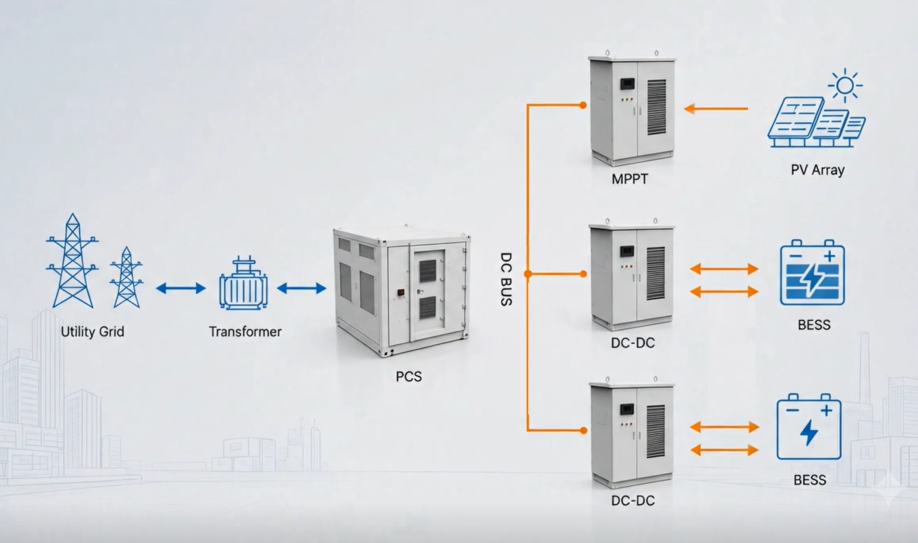
To meet the high-efficiency requirements of large-scale solar-storage projects, BOCO Electronics has launched its MW-to-GW-scale solar-storage DC-coupled solution. Through DC-DC conversion, solar power and energy storage batteries are connected to the DC side, and then unified grid connection is realized through PCS.
Solar power and energy storage can exchange energy directly on the DC side, reducing unnecessary AC/DC conversion stages. Meanwhile, the system controller coordinates solar power generation, battery charging and discharging, and PCS power output, enabling efficient collaboration among solar power, energy storage, and the grid.
In this solution, the core DC-DC module achieves conversion efficiency of up to 99.5%. When applied to MW- or even GW-scale projects, it helps reduce accumulated conversion losses, enabling more green power to be effectively utilized and supporting long-term project returns.
  
image.png

Energy Storage: Not Just Connected, but Controllable and Manageable

For large-scale solar-storage projects, the energy storage system must not only respond quickly, but also support refined management.
BOCO Electronics connects the energy storage system through DC/DC, enabling precise control of energy on the storage side. The solution supports:
1.Flexible charging and discharging management;
2.Refined power regulation;
3.Improved system operation stability;
4.Optimized energy utilization efficiency.
Whether supporting solar power generation for peak shaving and valley filling, maximizing self-consumption, or responding to grid dispatch requirements to provide auxiliary services, the system enables accurate and flexible power regulation. This allows the energy storage system to truly achieve efficient charging, reliable discharging, and flexible dispatch.

Modular Design for MW- to GW-Scale Projects

Large-scale solar-storage projects often involve long construction cycles, large capacity requirements, phased construction, and future expansion needs.
To address these demands, the BOCO Electronics solution adopts a modular design. DC-DC, PCS, and other power modules can be flexibly configured according to project capacity, supporting module-based expansion and phased project construction.
Whether for MW-scale projects or larger GW-scale applications, the solution can be configured based on site conditions, grid-connection capacity, and investment plans, leaving clear room for future expansion and operation and maintenance.

From System Solution to On-Site Application

The stable operation of large-scale solar-storage projects depends not only on product parameters, but also on system design, on-site integration, and long-term operation and maintenance capabilities.
BOCO Electronics has accumulated application experience in solar-storage system projects across Shandong, Shanxi, Tibet, Qinghai, and other regions. Based on different regional environments, project scales, and construction requirements, BOCO Electronics can provide support for system installation and integration, long-term operation and maintenance, and large-scale delivery.
Through DC-side coupling, high-efficiency DC-DC power conversion, refined energy storage management, and modular system design, the BOCO Electronics large-scale solar-storage DC-coupled solution enables lower solar power losses, stable energy storage integration, and efficient green power output.
If you are planning a MW- to GW-scale solar-storage project, BOCO Electronics welcomes the opportunity to connect with you and jointly explore large-scale solar-storage solutions that deliver higher efficiency, greater flexibility, and long-term value.

BOCO Electronics 800V HVDC Architecture: Building a Power “Highway” for AI Computing Centers

As AI racks consume more power, how should the power supply chain be upgraded?

From large model training to the deployment of AI inference applications, computing demand is growing rapidly. At the same time, data centers are undergoing major changes: GPU power consumption is increasing, rack power density is rising, and power supply systems are moving from behind the scenes to a critical position.
For 10MW-level or even larger-scale AIDC projects, the focus is no longer just whether there is enough power. The real question is whether electricity can be delivered to server racks efficiently and reliably.
The longer the power supply path and the more conversion stages involved, the greater the losses and heat dissipation pressure. These factors further affect electricity costs, system energy efficiency, and future expansion capability.
As computing power continues to grow, more AIDC projects are beginning to ask: should the power supply architecture be upgraded accordingly?

High-Efficiency HVDC Power Supply Solution for Computing Centers

To address this industry challenge, BOCO Electronics has launched its 800V HVDC architecture, which acts like a direct “highway” carrying power straight to server racks.
  
image.png
  
After utility power, solar power, energy storage, and other energy sources are connected, the system delivers power to AI server racks through a shorter supply path. By reducing intermediate conversion stages, it enables electricity to enter computing loads with higher efficiency.
Compared with traditional multi-stage conversion solutions, the HVDC architecture delivers the following advantages:

1. Higher Efficiency

Compared with traditional multi-stage conversion, the HVDC architecture reduces intermediate conversion stages. The system’s peak efficiency exceeds 99%, improving power conversion performance and reducing transmission losses.

2. Significant Energy Efficiency Improvement

In typical application scenarios, compared with traditional architectures, the overall system energy efficiency can be improved by up to 15%, helping reduce long-term operating costs.

3. Flexible Configuration

The solution provides multiple power options, including 625kW, 750kW, and 1000kW, allowing flexible matching according to project scale.

4. Smooth Expansion

The system can be flexibly expanded as the number of racks increases and load demand grows. This helps reduce resource waste during the initial construction stage while reserving sufficient space for future development.

Beyond Efficiency: Reliability Matters Just as Much

Once computing tasks are started, continuous operation becomes essential. While pursuing higher efficiency, the BOCO Electronics 800V HVDC architecture also places strong emphasis on system reliability.

Intelligent Protection

The system supports modular parallel operation, hot-swappable maintenance, and multiple protection mechanisms. Its modular and hot-swappable design makes later-stage maintenance faster and more controllable. When abnormalities occur, key protection mechanisms can be triggered in time, enabling faster fault location and easier handling, while minimizing the impact of maintenance on system operation.

Scenario Adaptability

In integrated scenarios such as solar-storage-computing applications, the system supports green energy access and energy storage backup, meeting the flexible power supply needs of next-generation data centers.
  
Currently, this solution has been validated in multiple overseas solar-storage-computing and complex power supply projects, fully demonstrating its system capabilities in green energy integration and high-density load power supply.
 
In the AI era, computing power is becoming a new form of productivity. With the design concept of “fewer conversion stages, higher efficiency, easier expansion, and greater reliability,” the BOCO Electronics 800V HVDC architecture provides stable and reliable energy support for high-density computing centers.
If you are planning a new AIDC project or an expansion project, BOCO Electronics welcomes the opportunity to connect with you and explore a more efficient power supply architecture together.

High Electricity Costs, Expensive Capacity Expansion, and Downtime Risks? Step Inside BOCO Electronics to Unlock the Optimal “Power Orchestration” Solution for Complex Energy Scenarios

Solar power, energy storage, diesel generators…
More and more energy sources are being connected to the same power supply system.
But more energy sources do not necessarily mean simpler power management.
High electricity costs, expensive capacity expansion, and downtime risks have become common challenges for factories, charging and battery-swapping stations, and remote areas.

How can different energy sources perform their respective roles while operating in coordination?

Ultimately, it comes down to one key question:
How should such a complex power system be orchestrated?
To address the power challenges of the multi-energy era, BOCO Electronics provides a deeper look into its integrated solution.
Step inside BOCO Electronics and see how intelligent energy dispatch enables solar power to be fully utilized, energy storage to be flexibly regulated, and critical loads to be reliably protected.
The BOCO Electronics PV-ESS-Diesel-Load Integrated Solution uses an integrated PV-ESS cabinet as the core hub to build a unified energy dispatch platform.
It connects solar power, energy storage, diesel generators, and various loads into one coordinated platform.
  
image.png
  
Based on on-site operating conditions, the system can flexibly set energy priorities:
Solar power is prioritized for local consumption, improving green energy utilization.
Energy storage supports peak shaving and valley filling, reducing peak-time electricity costs.
Grid power provides stable support for daily operations.
Diesel generators serve as backup when needed, responding to special working conditions and emergency scenarios.
  
Which energy source is used first, which one stays on standby, and which one steps in during emergencies can all be configured according to site conditions, enabling true “one-click power orchestration.”
The BOCO Electronics PV-ESS-Diesel-Load Integrated Electrical Cabinet adopts a modular design, covering multiple power configurations including 130kW, 260kW, and 520kW, with further expansion available to above 1MW.
  
All core power modules inside the system are self-developed. By adopting silicon carbide technology, the system delivers significant advantages in conversion efficiency and power density.

System Overview

130kW PCS: As the core module of the integrated cabinet, the PCS mainly adopts a three-phase four-leg design to support energy storage charging and discharging as well as AC power supply. It is well suited for common three-phase load imbalance scenarios in industrial applications.
45A Six-Channel DC-DC Module: Supports direct PV DC access, with conversion efficiency of up to 99.5%.
300–600kW Hybrid STS Module: Enables fast switching between grid-connected and off-grid modes, with efficiency of up to 99.9%.
Ultimately, the system brings customers a more stable power supply experience, lower energy losses, and reduced downtime risks.

Three Typical Scenarios: Precisely Solving Power Challenges

1.Industrial Parks: Maximizing the Value of Every Kilowatt-Hour of Green Power

In a microgrid project for an industrial park in Changzhou, the customer required the system to:
Increase the proportion of solar power consumption;
Reduce peak-time electricity purchasing costs;
Ensure continuous power supply for critical loads.
  
To meet these needs, the system realizes intelligent dispatch:
During the daytime, solar power first supplies production loads, while excess electricity is stored in the energy storage system.
During peak tariff periods, the energy storage system discharges to reduce peak electricity purchasing pressure.
When grid power becomes abnormal, the system prioritizes critical loads and enables seamless switching between energy storage and grid power, helping prevent production interruptions.
Energy is not only “used,” but also intelligently managed.

2.Charging and Battery-Swapping Stations: Breaking Through Capacity Expansion Constraints

For charging and battery-swapping stations, the biggest concern is often this:
When vehicles arrive and chargers start operating, the load can surge instantly.
In this scenario, the energy storage system acts like a “power buffer.”
By storing electricity during off-peak periods and releasing it during peak demand, the system helps stations smooth instantaneous load fluctuations through peak shaving and valley filling, easing capacity expansion pressure and improving the utilization of existing power distribution resources.

3.Remote Areas: Reducing Dependence on Diesel Power Generation

In areas such as islands, fishing villages, and border outposts, grid access conditions are often limited.
Long-term reliance on diesel power generation leads to high fuel consumption and high maintenance costs.
By building a local microgrid, the system can achieve:
Solar power generation and energy storage during the daytime;
Continuous power supply from the energy storage system at night;
Diesel generator backup during consecutive rainy days or special operating conditions.
  
While meeting the power needs of daily living, communication, and critical equipment, the system helps reduce diesel generator runtime, lowering fuel consumption and operation and maintenance costs.
From “power supply” to “power orchestration.”
Against the backdrop of energy transition, the challenge enterprises face is no longer just whether power is available.
It is about how to make solar power fully utilized, energy storage flexibly dispatched, and critical loads reliably protected.
What the BOCO Electronics PV-ESS-Diesel-Load Integrated Electrical Cabinet aims to solve is not merely a single power supply issue.
  
It addresses the broader challenge of coordinated energy dispatch in complex energy scenarios.
If your project is facing challenges such as high electricity costs, expensive capacity expansion, or unstable power supply, BOCO Electronics welcomes the opportunity to connect with you.
Together, we can find a more efficient way to orchestrate your power system.

Get a Free Quote

Our representative will contact you soon.
Email
Name
Company Name
Message
0/1000