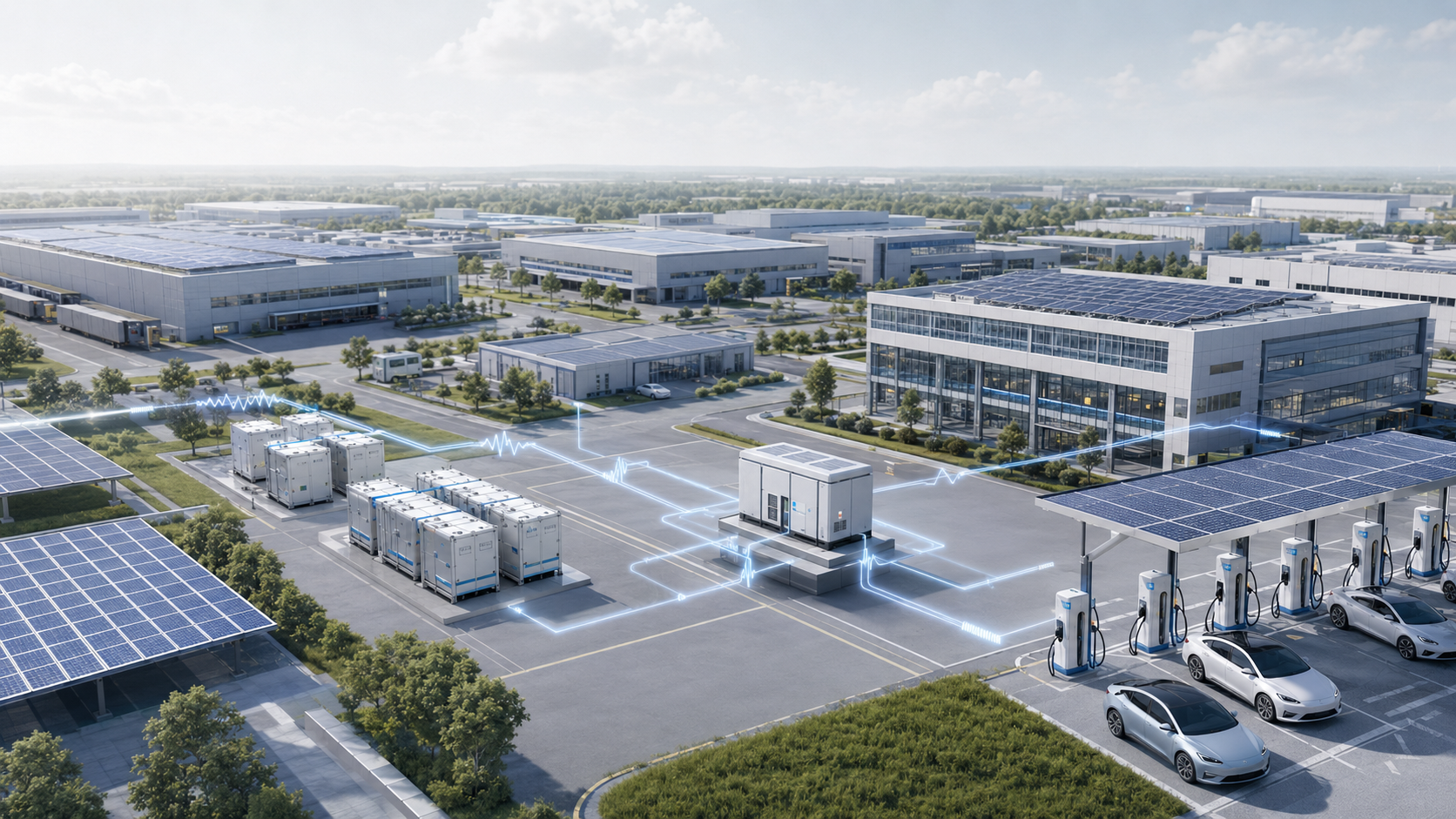
As distributed photovoltaic (PV) systems, energy storage and new energy vehicle charging demand rapidly expand into industrial parks, solar-storage-charging microgrids are evolving from "device-level access" to "system-level synergy".
However, real-world deployment faces multiple challenges: batteries of different types differ in voltage platforms and charge-discharge characteristics, PV power output is inherently volatile, and high-power charging loads fluctuate sharply.
Enabling stable integration of multiple energy sources into DC systems, with efficient conversion and flexible regulation, has become the core challenge for large-scale rollout of industrial park microgrids. The largest industrial park-level microgrid in Jiangsu Province has been commissioned at the Innovation Industrial Park of Wujin National High-Tech Zone.Covering an energy supply area of 370,000 square meters, the project deploys 1.61 MW of distributed PV systems and a 6,035 kW / 10,660 kWh energy storage system. A unified microgrid management and control platform coordinates PV generation, energy storage, charging facilities and adjustable loads across the park.
After operation, the project is expected to reduce annual energy costs by approximately RMB 4.6 million, cut carbon dioxide emissions by 7,585 tonnes, and achieve an investment payback period of around 4.5 years.
For the DC microgrid segment of the project, 40 units of ProPower Electronics' 125kW bidirectional DC-DC converters — Gemini 125H — are deployed on both the energy storage and PV sides. Specifically, 20 units are paired with sodium-ion energy storage batteries, 10 with lithium iron phosphate (LFP) energy storage batteries, and 10 with PV arrays, providing voltage matching, power regulation and energy conversion support for diverse energy sources connecting to the DC busbar.
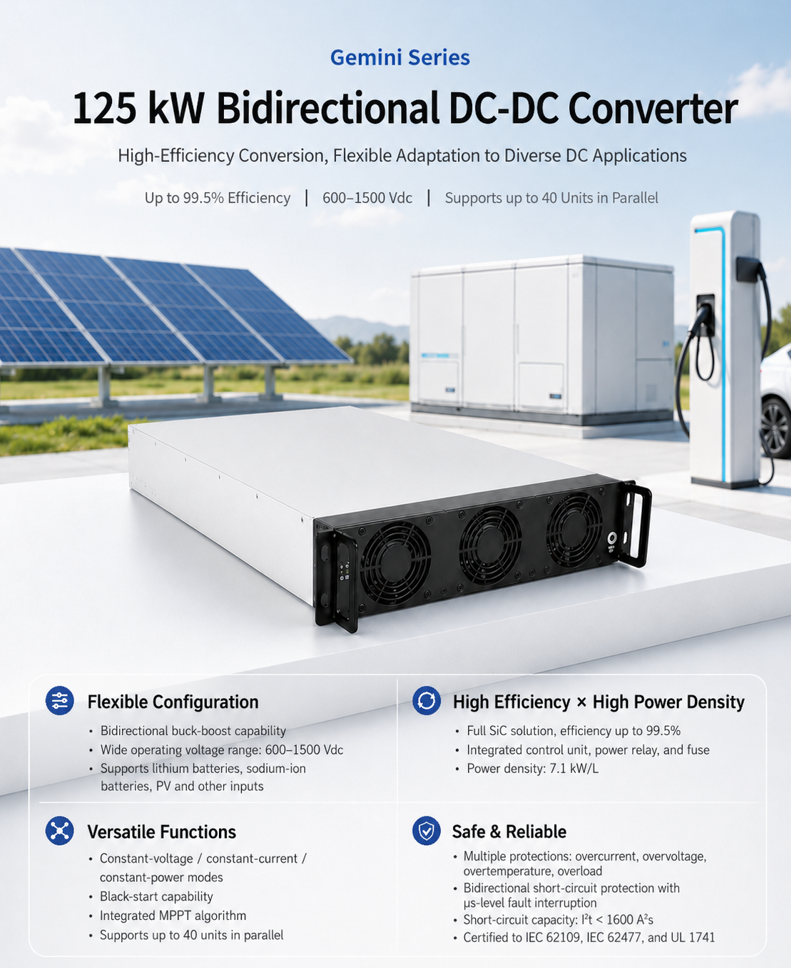
ProPower Electronics 125kW Bidirectional DC-DC Converter — Gemini 125H
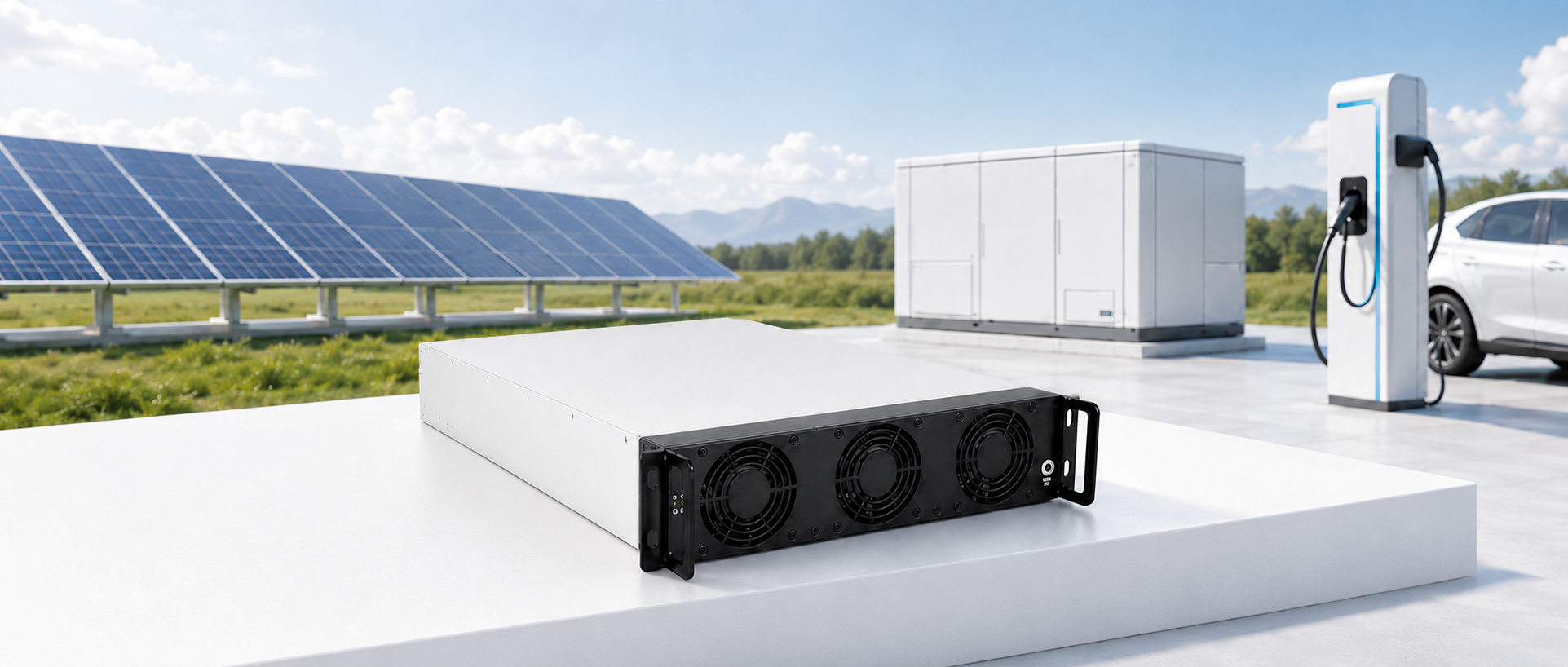
Built to meet the demand for multi-source heterogeneous integration in industrial parks, the Gemini 125H features bidirectional buck-boost capability with an operating voltage range of 600–1500 VDC, compatible with inputs including lithium batteries, sodium batteries and PV systems. It supports multiple operation modes — constant voltage, constant current, constant power and MPPT (Maximum Power Point Tracking) — to satisfy the needs of bidirectional energy storage charge/discharge and PV energy integration.
The product delivers a maximum continuous power of 125 kW, a peak conversion efficiency of 99.5%, and a power density of 7.1 kW/L and 7.35 kW/kg, reducing energy conversion losses while saving system deployment space.
Its modular design brings flexible deployment: supporting parallel operation of up to 40 units, the system can be freely configured based on project capacity, and reserves room for later expansion.
Adapted to the harsh operating environment of industrial parks, the Gemini 125H is equipped with comprehensive electrical protection mechanisms and strong anti-interference performance, integrating over-current, over-voltage, over-temperature, overload and bidirectional short-circuit protection to guarantee long-term stable equipment operation.
The microgrid management and control platform handles energy forecasting,
optimization and coordinated scheduling, while DC-DC converters execute power conversion and power regulation. Working in tandem, they enable truly "accessible, adjustable and synergistic" operation across PV systems, diverse energy storage assets and charging loads.
Leveraging its high-performance power conversion technologies, ProPower Electronics provides DC-DC products and supporting technical services tailored to project-specific battery types, DC busbar voltages, PV capacities and load profiles, helping customers achieve flexible multi-energy integration, highly efficient energy conversion and smooth system scaling.
Going forward, ProPower Electronics will continue its R&D innovation, and deliver more high-efficiency, highly adaptable, modular power conversion products to provide core equipment support for solar-storage-charging microgrids and DC power distribution scenarios in more industrial parks.

 EN
EN